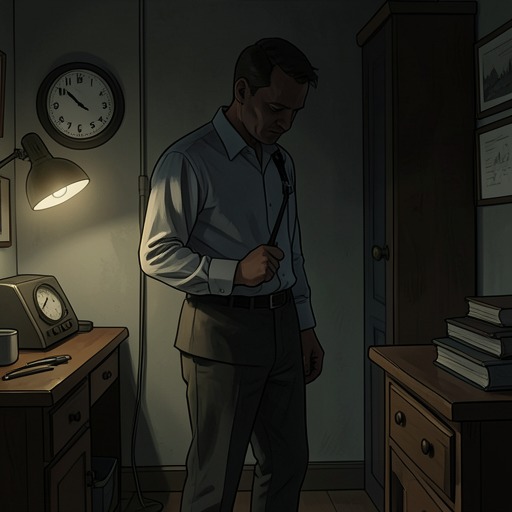
Willie Keith's transition from naval officer to civilian life
The Caine Mutiny Court-MartialWillie Keith’s transition from naval officer to civilian life is portrayed not as a clean homecoming but as the dismantling of an identity. When the Caine leaves Okinawa for decommissioning, Willie recognizes that the war is ending, yet the habits and sense of self formed at sea do not disappear with it. By the time the ship is stripped and handed over at Bayonne, his Navy life has ended in fact, while his return to civilian life remains emotionally incomplete: he feels no longer a naval officer, but not yet his former self.
The return from Okinawa
Two days after Willie makes his case for sending the crews home, the Caine and the Moulton receive orders to proceed to the Naval Supply Depot in Bayonne, New Jersey, by way of Pearl Harbor and the Panama Canal, for decommissioning. The order turns the end of the war into a route and a task. For Willie, however, departure from Okinawa has an unexpected emotional cost. On the bridge he watches the island recede until its last green rise disappears, and at that moment the war’s conclusion becomes real: he had left home three years earlier, crossed half the world, and reached a place that had once been strange and unknown. Now he is going back.
The return voyage makes clear that his body and attention still belong to wartime. With the Moulton’s portholes glowing yellow and its red, green, and white lights showing at night, Willie is startled by a normal peacetime sight. He continues to observe blackout precautions, crushing his cigarette before leaving his cabin, keeping light from escaping through the chartroom curtains, and covering his flashlight lens with his fingers. The absence of the sound search’s familiar pings unsettles him; so do the guns, secured and covered with canvas. Having experienced the sea and the Japanese as a single enemy, he must consciously remind himself that the ocean does not produce submarines as it produces flying fish. Peace arrives first as a changed set of conditions that his instincts have not caught up with.
The sea as a vanishing world
Willie spends long hours on the bridge even when he has no duty there. He knows that the stars, sea, and ship are slipping out of his life, and imagines that within a few years he will no longer be able to tell the quarter-hour by the Big Dipper, recall the precise course correction for a cross sea, or locate the speed-indicator buttons in darkness. These are not abstract professional skills: they are knowledge fixed in his muscles by repetition. The wheelhouse, familiar to him as his own body, will soon cease to exist as the setting of his daily life. He experiences that anticipated loss as a little death, so that the journey home is also a journey away from the world that has taught his body how to act.
At Pearl Harbor, his first action is to seek May Wynn. He goes to the Navy Yard telephone exchange and calls the candy store in the Bronx, waiting two hours among battered furniture and old picture magazines. One magazine forecasts an invasion of Japan and predicts that the war will last until the spring of 1948, a remnant of the uncertainty from which Willie is trying to emerge. When the operator finally tells him that May is no longer at the number and that the man who answers does not know where she can be reached, the homeward voyage offers no immediate reunion with his former private life. His military world is ending, but the personal life he hopes to resume is not simply waiting in place.
An identity between roles
Near the end of the voyage, Willie’s rise to command still seems strange to him, though at Okinawa the Navy identity had continued to possess him. The change becomes sharper as the ship approaches the East Coast and familiar landmarks return. He has taken a United States warship through the Panama Canal, past Florida, and into New York Harbor, threading among ferryboats and liners; from the bridge he sees the skyline and the Statue of Liberty as Captain Keith of the Caine. Yet approaching the places of his earlier life does not restore his earlier personality. Instead, he feels his military identity dissolving into the sea air, leaving only Willie Keith, while the old self seems as ill-fitting as an outdated fashion. The familiar coast makes the break visible without resolving it.
The transition is therefore not simply from service to civilian employment, but from one organizing role to an uncertain interval between roles. The military personality is receding, while the prewar boy cannot be resumed unchanged. That uncertainty gives the weeks homeward their dreamlike quality. On October 27, with the decommissioning ceremony half an hour away, Willie sits in the Caine’s cabin wearing his bridge coat against the raw air and reads Pascal’s Pensées. He underlines, “Life is a dream, a little more coherent than most.” The words describe the unreality of having brought the ship through the canal and into New York, but also the strangeness of becoming Captain Keith in a world where that identity is about to end.
The ship’s final handover
By the time the Caine is ready for decommissioning, it has been tied up at Bayonne for three days, stripped of its guns and emptied of ammunition and fuel. The paperwork is finished; the ceremony marks the end of the trail. Willie’s own career is represented in the red cardboard folder where he keeps his orders to Furnald Hall and to the Caine, his commission, promotions, and applications for transfers to submarines, ammunition ships, underwater demolition squads, mine-disposal units, dangerous assignments, and Russian-language school. He had submitted those applications in moments of despair during the Queeg year, and Captain Queeg had disapproved them. Willie puts his citation and letter of reprimand side by side in the folder, preserving the contradictory record for descendants who might one day puzzle over it. The documents reduce a complicated career to papers, including both recognition and censure, as the institution that gave the career its form is closing around him.
After the ship’s company has been dismissed, Willie hands over the keys and records while the decommissioning detail takes charge. The yeoman brings him the last logs to sign; steward’s mates carry his bags to the dock. A sailor brings the wrapped union jack, which Willie addresses to Horrible’s parents and tells him to mail. When the chores are done, Willie walks down the abandoned gangplank without saluting: there are no colors to salute and no officer of the deck. The Caine is junk. The absence of the ordinary forms of naval respect makes the ending concrete. He has not merely left a ship; the ship and its routines have been formally emptied of the life that made them his command.
Homecoming without resolution
A yard jeep takes Willie to the gate, where Mrs. Keith waits in a new tan Cadillac. She has driven to Bayonne every day since the Caine arrived, and now it seems natural that she should take him home. Willie dislikes the arrangement. In his thought, she had driven him to the Navy’s gates and is now driving him back home: the little boy is finished with the sailor game. The phrasing registers both a real departure from childhood and his discomfort at being returned to the maternal home as if the intervening years could be reversed.
Willie has still been unable to find May. Repeated calls to Marty Rubin’s office fail because the agent is out of town, and his mother says nothing about May. Willie interprets her silence as confidence that she has won their struggle over his future once and for all, but the narration makes clear that he is mistaken. Mrs. Keith avoids the subject out of fear: since her February visit, her son seems to have aged in his eyes, gestures, bearing, and voice. The careless, ruddy boy has become a gray-toned adult, and she wants him back in the big empty house without giving him an opening to declare his independence. Their opposing readings of the silence expose the unresolved terms of his return. Willie is no longer the boy who left, but neither his mother’s home nor the vanished wartime world supplies an immediate answer to what he will become. The decommissioning closes his naval service; the passage leaves civilian life beginning in uncertainty.